If I Can’t See It, Are You Really Doing It?
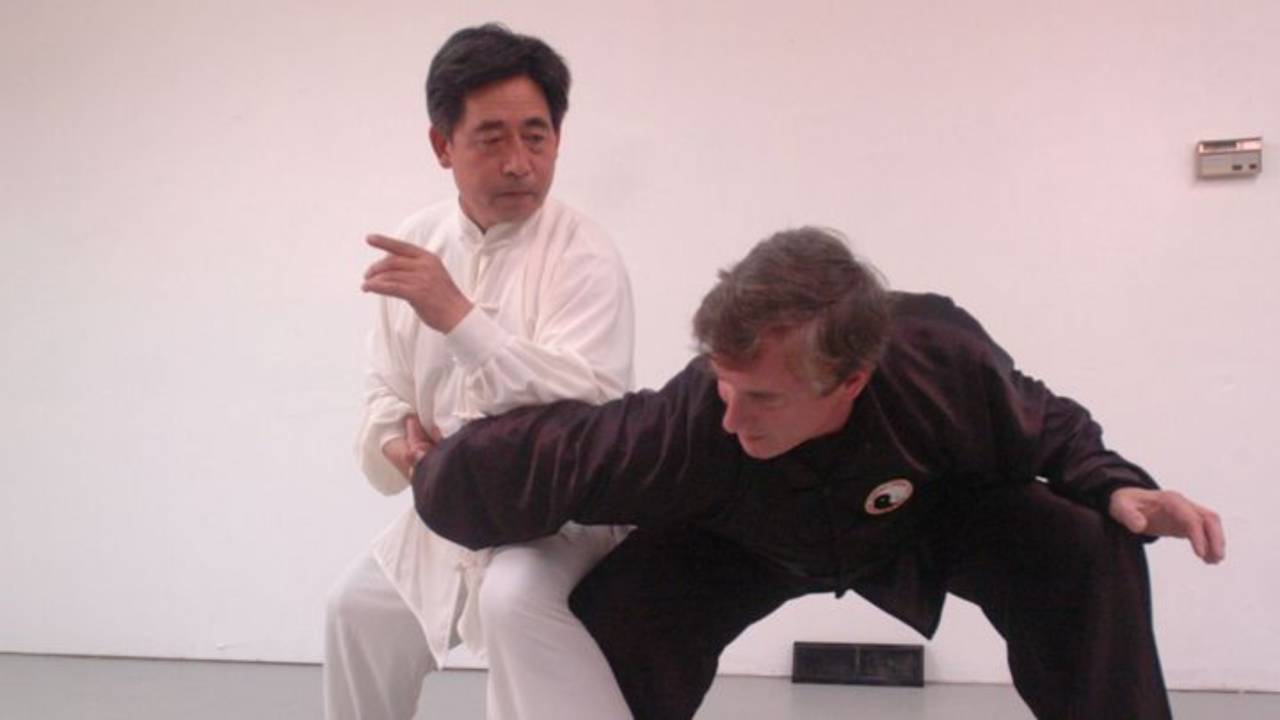
(Photo above shows Ken training with Chen Xiaoxing in 2006)
One of the reasons I switched from Yang style to Chen style Taijiquan in 1998 is because Chen Taiji looked so “alive.”
The body mechanics of Chen style involve spiraling and Dan T’ien rotation, closing and opening, folding in the chest and stomach, and relaxing into the kua (especially the crease at the top of the legs). Instead of high stances, Chen style stressed “sitting in the chair.”
None of these mechanics were taught to me in Yang style. When I switched to Chen style, I began learning things from the “original” style of Taiji that apparently had been lost in Yang style, or at least in the type of Yang style taught in America.
When I talked to a couple of Yang folks about this, they would reply, “Oh, we’re doing it, you just can’t see it.”
Nope. I didn’t just fall off the turnip wagon. If I can’t see it, you ain’t doing it.
Okay, maybe "If I can't see it, you ain't doing it" is overstating the case. But if a trained observer who knows what he's looking for can't detect the closing, opening, kua action, the whole-body connection or dantian movement, at some point we have to ask what exactly is happening.
For more than a decade, I was taught in Yang style to think more about “cultivating Qi.” I was not taught how to move the body for relaxed power.
The Body Method
A body method is a unique set of body mechanics that come into play in a certain activity. The mechanics are different for Taiji than for baseball, and the body method for baseball is different than for soccer.
To me, after ten years of doing Yang style, the body method seemed dead compared with Chen style. Within an hour of meeting Jim Criscimagna, my first Chen teacher, I knew I had to start over.
To this day, I still teach the Chen forms that came from the Chen Xiaowang line.
So here is my problem, and I say this with people I respect still firmly entrenched in the Chen Xiaowang/Chen Xiaoxing way of doing Taijiquan; great people who are dedicated to carrying on the art of Taijiquan.
As time marches on and I see more recent video of Chen Xiaowang, Chen Xiaoxing and their students, I see less and less of the “alive” movement that attracted me to Chen style.
Chen Xiaowang is in his 80s now, and Chen Xiaoxing is my age. They show less and less of the mechanics I love. And for the past few years, it’s hard for me to detect much of what is commonly called a “body method.” That is understandable in teachers who are getting up there in years, but younger generations should reflect a more vital and vibrant way of moving.
When I saw Nabil Ranné move in 2020 – he is a disciple of Chen Yu – I saw the “alive” quality I wanted to develop. And when I began studying with him, I saw him dive into details of the body method in each class. I’ve been with him for six years now.
The body method is sometimes called a “dragon body.” I like that description. Some call it a “serpent” body. Dragon seems to fit better.
It’s interesting to me how, within the same family -- the Chen family -- the body methods can vary so much. It might have something to do with geography.
Chen Fake moved from the Chen Village to Beijing in 1928. His son, Chen Zhaokui, was born and lived in Beijing, and Zhaokui’s son, Chen Yu, still lives there. So I think of my training in Chen style as involving both the Village and the Beijing way. So does my teaching.
Chen Zhaopei also moved to Beijing in 1928. At a later time, after Taiji began declining in the Chen Village, Zhaopei returned in 1958 to teach. He taught traditional Laojia (Old Frame) routines and weapons sets for the next generation, including the famous "Four Tigers of Chen's Village" (Chen Xiaowang, Chen Zhenglei, Zhu Tiancai, and Wang Xian).
By the way, Chen Fake was also the grandfather of Chen Xiaowang and Chen Xiaoxing. So, it is all the family art. But it developed differently in Beijing. Chen Fake’s son, Chen Zhaokui, who was a great master himself, visited the Chen Village at various times to teach, but the Taiji of the “Four Tigers” primarily represented Chen Zhaopei’s teaching.
Different teachers have different stylistic philosophies. In fact, I read something that Chen Xiaoxing apparently teaches now. He is quoted as saying, “If I can see it, it’s too much.”
I never heard that when I studied directly with Mark Wasson and Chen Xiaoxing. During a week at my house, which involved a lot of training in my basement and at my school, Xiaoxing never said, “If I can see it, it’s too much.”
But I suppose that is the guidance now – not so show anything – to make it so small, it can’t be detected.
I don’t get it. If I can’t see it, how do I know you have it?
If I can’t see it, what makes Chen style look different from Yang style?
There is an old Taiji saying that goes something like: “At first your movements are big. Then they get smaller and smaller.”
There is some truth to that. And a lot of masters teach beginners to make their movements big for a long time. They make external and internal mechanics big, then make them smaller over time.
I stood in front of Chen Xiaowang at a workshop near Washington, D.C. and I wanted to impress him with how well I could close into the kua. I really closed into it deeply. He stopped me.
“Too much,” he said.
Then he demonstrated. Chen Xiaowang sunk into his left kua a little bit and said, “Just enough.” Then he let the Hidden Hand Punch fly.
I got the message. I could see him sink into the kua, but I had taken it too far.
He didn’t say, “Don’t let anyone see you sink into the kua.”
He didn't make the movement disappear. He refined it. There is a difference between eliminating excess movement and eliminating the body method.
If you’re doing it, a trained observer should see it.
I have a lot of respect for the masters of the Chen Village. As I said earlier, for the past six years I have trained with Nabil Ranné, who is a disciple of Chen Yu. In this lineage, which goes from Chen Fake to Chen Zhaokui to Chen Yu and to Nabil, you can see the internal mechanics reflected in the movement.
It looks “alive,” like Chen Taiji should look. That’s what got me interested in the first place.
Give me the dragon body. It's what I'm trying to develop.
If I practice so you can’t see my body method, what happens when I need it for self-defense? Show me someone who can fight using movement and mechanics that are not perceptible. Show me someone who trains for self-defense by moving so you can’t see how the power is being generated.
I have done too much sparring and wrestling to believe you can develop effective movement by practicing in a way that suppresses the very mechanics you're supposed to use. To use something effectively, you must practice it effectively. And making it invisible isn’t the way to do that, in my humble but somewhat educated opinion.
The goal in Taiji fighting is not to make your body mechanics nonexistent. It's to make your intention unreadable. Those are two different things.
It is difficult to learn how to reflect the Dragon Body way of moving. I'm still trying to do it well. It isn’t our natural, stiff way of moving. And perhaps, over time, an emphasis on making movement smaller can result in students who simply don't show much of anything. “One….two….three…..four….follow me” is not the way I like to be taught. It's also not the way I like to teach. And perhaps, over time, an emphasis on making movement smaller can result in students who simply don't show much of anything.
Perhaps if it is too difficult, more people would run away. The intricacies of good internal movement make it a very difficult art to learn well. I don't know why this trend of hiding the mechanics has developed. Perhaps it reflects the demands of teaching large groups, an older student population, or simply a different philosophy of practice. But whatever the reason, I think something important risks being lost.
So here is my bottom line: Don’t hide it. Show it. Or at least, show what makes Chen style unique and powerful. If your torso and Dan T’ien area aren’t alive as you move, if your knees wobble and collapse and you move your hips in space instead of using the kua and internal movement, why should I study with you?
Good Taiji makes unnecessary movement smaller. It doesn't make the body method disappear.
If the Dragon Body is “too much” – if you hide everything so that nobody can see it (assuming you had it to begin with) – I’m afraid Chen style will change to look as dead as most of the Yang style I see. The body method will be gone.
Then, if someone tells you that you aren't doing certain internal movement, you can say, "Oh, I'm doing it. You just can't see it."
I hope that doesn’t happen.
--by Ken Gullette
Try Two Weeks Free and Get Step-by-Step Training in Taiji, Xingyi and Bagua from Basic to Advanced Skills with No Mystical Mumbo-Jumbo
More than 850 Video Lessons and Downloadable pdf documents -- and You Get It All During Your Free Trial!
Click this Button to Learn More and Watch a Video!
Author - Instructor
Ken Gullette
I have practiced martial arts since 1973 and began studying the internal arts in 1987. My goal is to cut years off your development time by coaching you in the real skills for high-quality Tai Chi, Xingyi, Bagua. To see more about my bio, click the "About Ken" link on the menu at the top of this page.
Stay connected with news and updates!
Recent Posts
Categories
All Categorieschen taiji fighting applications
chen xiaowang straight sword form
critical thinking in martial arts
does tai chi make you live longer?
full contact vs point sparring
how to succeed in martial arts
how to use chi kung in daily life
how to use qigong in daily life
internal fighting arts podcast
ken gullette on kung fu conversations podcast
mindset of successful martial artist
principles of body mechanics in martial arts
the myth of longevity in tai chi
understanding tai chi energies
what is body method in tai chi